
Product
Hot News



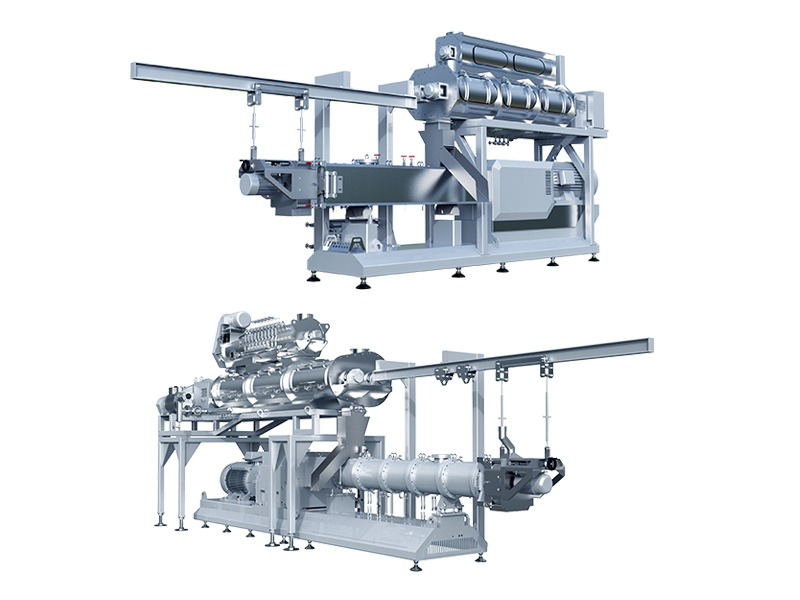
It is highly versatile, capable of processing and producing a full range of aquatic feeds, including floating, sinking, slow sinking, and micro aquafeeds, across various formula types.
Performance Characteristics
01 Stable, Reliable Operation with Low Failure Rate
Built for longevity and consistency, the extruder features a gearbox designed and processed to stringent international standards (European and American). It utilizes 5th grade high-precision gears and first-class brand bearings and oil seals, guaranteeing efficient transmission and stable operation. The machine is further equipped with a new wear-resistant alloy screw boasting an extended service life of over 4000–5000 hours.
02 Uniform Pellets with High Gelatinization
This extruder ensures superior pellet quality. Through uniform and efficient conditioning, optimized screw configuration, and CFD simulation for discharge device and die hole distribution, the system produces highly uniform extruded pellets. This precision results in an expansion coefficient variance of ≤0.1 and a gelatinization degree exceeding 95%.
03 Broad Processing Range and Formula Flexibility
The machine can handle a wide variety of formulations:
It covers high, medium, and low-grade floating, sinking, and slow sinking feeds.
It can produce small pellets, including 0.6mm die hole floating feed and 0.8mm die hole sinking feed.
It is capable of producing micro pellets for fry feed using die holes from 0.4mm–0.5mm.
It can process 7%–10% starch formulas to meet specific market demands.
04 High Automation for Consistent Product Quality
The extruder features a modular intelligent control system with independent monitoring of key parameters, resulting in a high degree of automation that minimizes manual variation. Standardized modules include: automatic feeding, one-click preheating, one-click conditioning, one-click startup (for the extruder and auxiliary devices), automatic mechanical energy control, one-click shutdown, and one-click extruder cleaning. These features significantly reduce the need for manual labor while ensuring uniform product quality.
05 Optional Preconditioner Waste Control
An optional preconditioner waste control function is available to help facilities further reduce material loss and lower overall production costs.


 Home
Home Products
 Solutions
 Telephone