
Product
Hot News



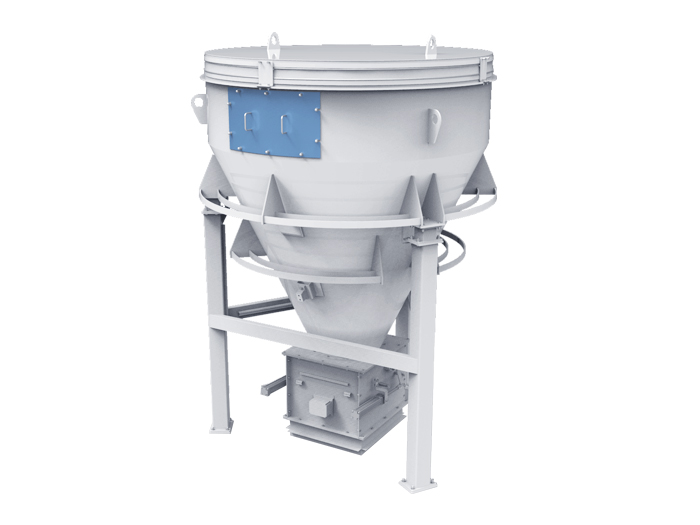
It offers extensive applications, designed for the accurate weighing of various materials prior to mixing. Its core advantage is the automatic calibration of the scale body, eliminating the need for manual handling of weights, which significantly enhances both production efficiency and formula accuracy.
Performance Characteristics
01 High-Quality Precision Weighing
The hopper supports batch weighing capacities from 500 to 3000 kg and is refined to ensure precise weighing, even of micro-ingredients. It utilizes Toledo brand sensors (conventional TSC/TSB models, with optional weighing module sensors). With a precision grade of C3, it achieves a static accuracy of ±0.1% and a dynamic accuracy of ±0.3%, guaranteeing measurement accuracy. The scale body is designed with a 65°cone angle, and can be optionally equipped with a pneumatic hammer or vibrator to ensure minimal residue.
02 Simplified Installation and Layout
Installation flexibility is key. Based on the customer's equipment layout, the batching hopper can be configured with either a support or suspension structure. This modular design allows it to be easily disassembled for convenient on-site installation and adaptable plant arrangement.
03 Versatile Discharge Gate Options
The hopper provides options to accommodate different formulas:
For conventional feed formulas, a square scale door discharge is available (standard cylinder brand is Hengli, with optional upgrades to SMC and Festo).
For high bulk density formulas, such as stone powder or calcium hydroxide, a butterfly valve discharge can be selected (standard butterfly valve brand is WAM, with customization available for other brands).
04 Automated Calibration for Efficiency
The automatic calibration feature significantly improves stability by resolving the occasional errors and inconsistencies in repeatability associated with manual calibration.
Automatic Control: The calibration frequency is flexibly set according to production needs, aligning with intelligent industrial development.
Time Savings: Calibration time is reduced from an extensive span of several hours for ordinary scales to just 1 minute.
Reduced Labor: This automation significantly lowers work intensity, eliminating the constant manual movement of weights and improving the working environment.

 Home
Home Products
 Solutions
 Telephone